Claim Earth: Simulating, Rendering, and Colliding with a Texture
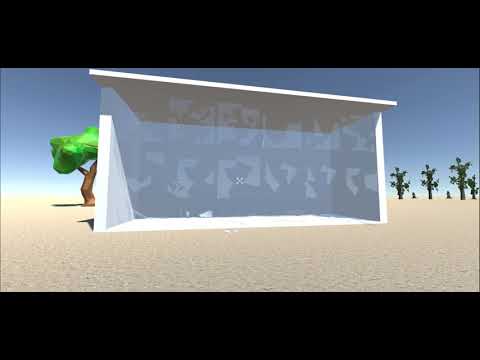
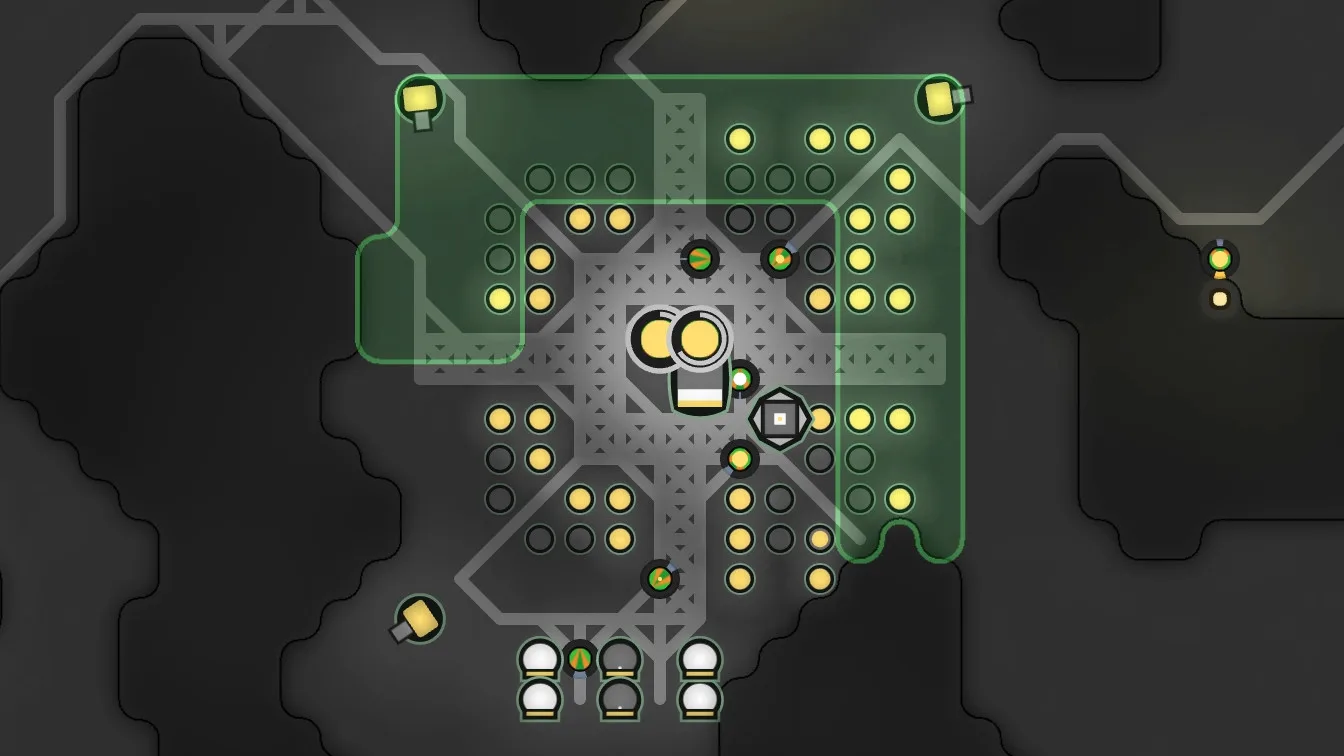
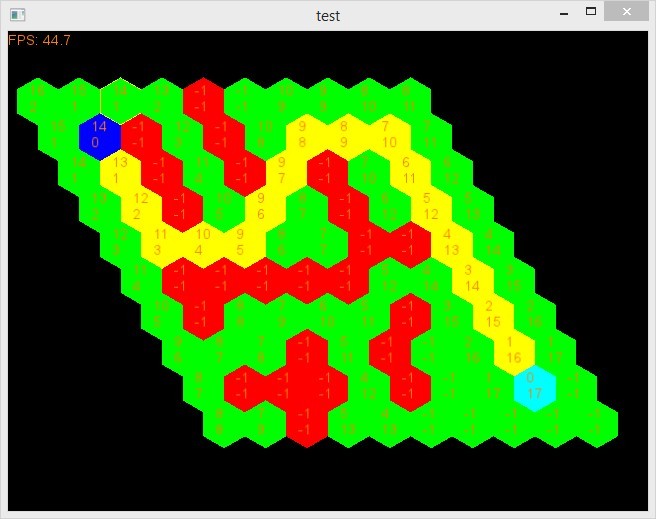
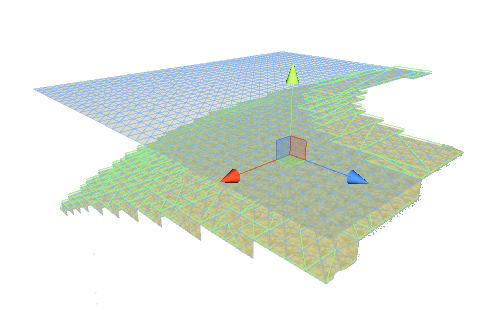
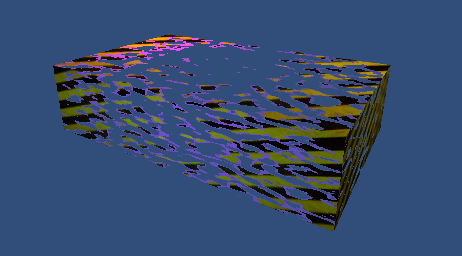
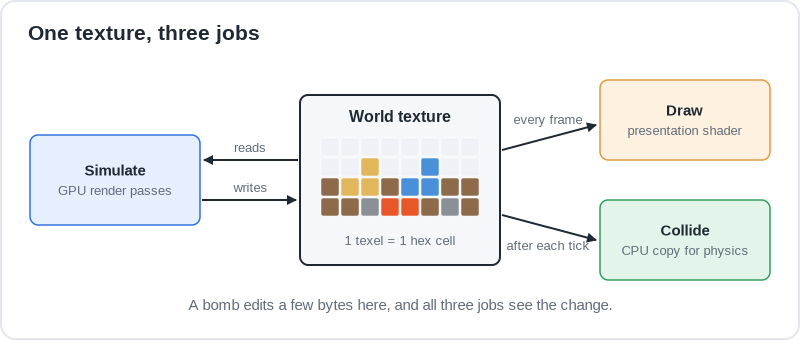
How Claim Earth stores its hex world in a texture, simulates sand, water, lava and gas with GPU render passes, draws the cave with a single shader, and lets the player collide with it.
Technical deep dives, design notes and devlogs from the games I build.
How Claim Earth stores its hex world in a texture, simulates sand, water, lava and gas with GPU render passes, draws the cave with a single shader, and lets the player collide with it.
How the first version of Claim Earth came together for a 3-hour jam: a plan written before the clock started, a hex cave with sand, water and lava, bombs, a grappling hook and a flag.
A month of building a cozy asteroid-mining browser game to learn React, Node and PostgreSQL: game design, scheduled domain events, a player journal and a canvas station.
How my Unity glass system clips a hand-drawn crack pattern on a window, rebuilds the shards as polygons, and extrudes them into meshes that can break again.
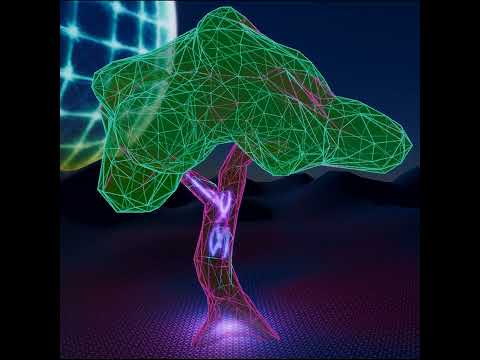
A glowing wireframe tree built from a Blender skin skeleton, with Python operators that bake depth and radius per vertex and a custom mesh format to bring them into Unity.
Solving CodinGame's Mars Lander Episode 3 by rasterizing the terrain, running A* and following the path with simple control rules, plus a look at my Screeps AI and Rosil.
The first block of a PvP programming game inspired by Colobot: a small indentation-based language, its C++ tokenizer, a C# language server and a VS Code extension.
A third-person Zelda-like prototype in Unreal Engine: Z-targeting style lock-on, auto-jump off ledges, a data-driven item and equipment system, menus and settings, ported from UE 4.27 to UE5.
A Guild Wars 1 inspired 4v4 arena prototype in Core: an 8-slot skill bar, energy with regeneration pips, tab targeting, server-side projectiles and a match manager, all in Lua.
Seven months of evenings on a Unity mobile top-down shooter: auto-targeting abilities, an energy loop, waves, loot tables and a tamper-checked save file.
A Unity strategy prototype: sail a boat, harvest islands, grow hexagonal floating stations and prepare them for endless enemy waves. The design, and the code that exists so far.
A Unity tool from 2015 that builds chunked 3D meshes for a hexagonal map, with cliffs, beveled edges and a brush to paint tiles in the scene view.
A month of JavaScript for Screeps, the MMO strategy game played only through code: role modules, spawn priorities, static mining, remote rooms and defense.
Hop Boy, the first mobile game from SupremApp, is out on Android and iOS. Here is how its infinite tower is assembled from tagged, rule-driven modules.
My Ludum Dare 35 entry on the theme Shapeshift: a car that turns into a rocket, built solo in Unity in about 20 hours, with an online leaderboard.
A school project in C#: a genetic algorithm teaches a two-wheeled robot with one arm to drag itself forward in the anyKode Marilou simulator.
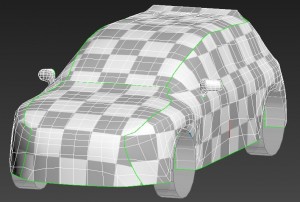
After trying 3ds Max, ZBrush and Photoshop, I'm keeping Blender for modeling and adopting Substance Painter for textures. Here is a car to show the result.
How I built Portal-style portals for Cursor Machina: a modified mirror shader for rendering, and seamless teleportation that holds up at high speed.
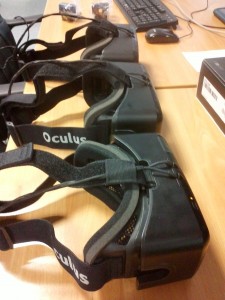
A few weeks of building an Oculus Rift DK2 application during my internship: resolution, motion sickness, the 75 fps requirement, and the missing hands.
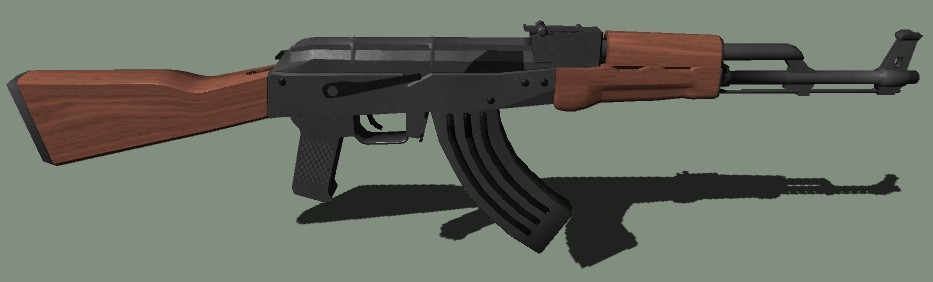
A low-poly AK-47 WASR-10 modeled, unwrapped and textured in about 12 hours, with a time breakdown and a comparison against models sold on TurboSquid.
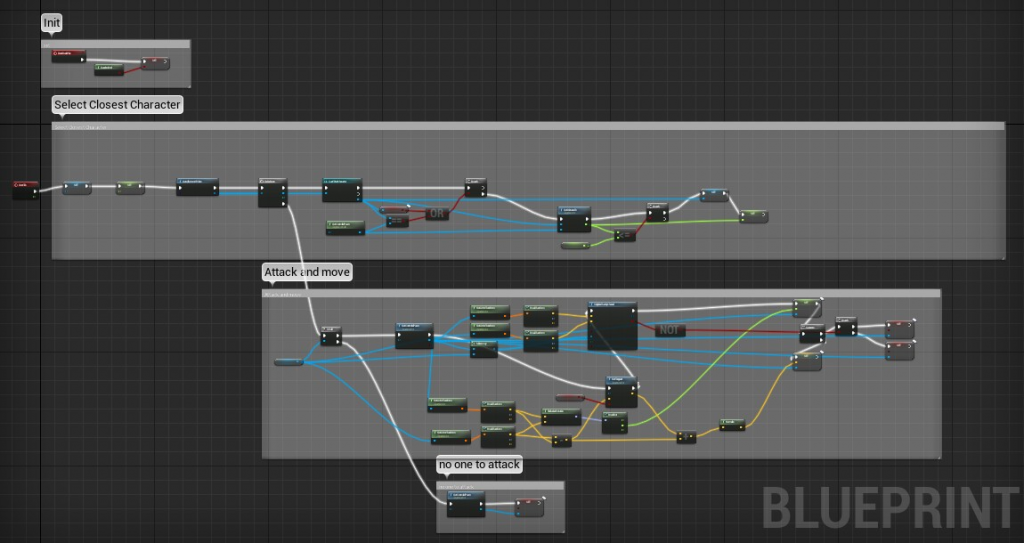
A small multiplayer prototype built entirely with Unreal Engine 4's Blueprint visual scripting, and when it makes sense to drop down to C++.
A small C++ and SFML 2D engine with a hexagonal tile map and A* pathfinding, plus the coordinate pitfalls of drawing and picking hexagons.
Introducing Cursor Machina, our six-person Epitech project: a first-person runner inspired by Mirror's Edge, with time rewind, replays and online scores.
A Unity prototype built to illustrate my game design concept for this year's course: defend Earth from waves of incoming asteroids. Now also on Android.
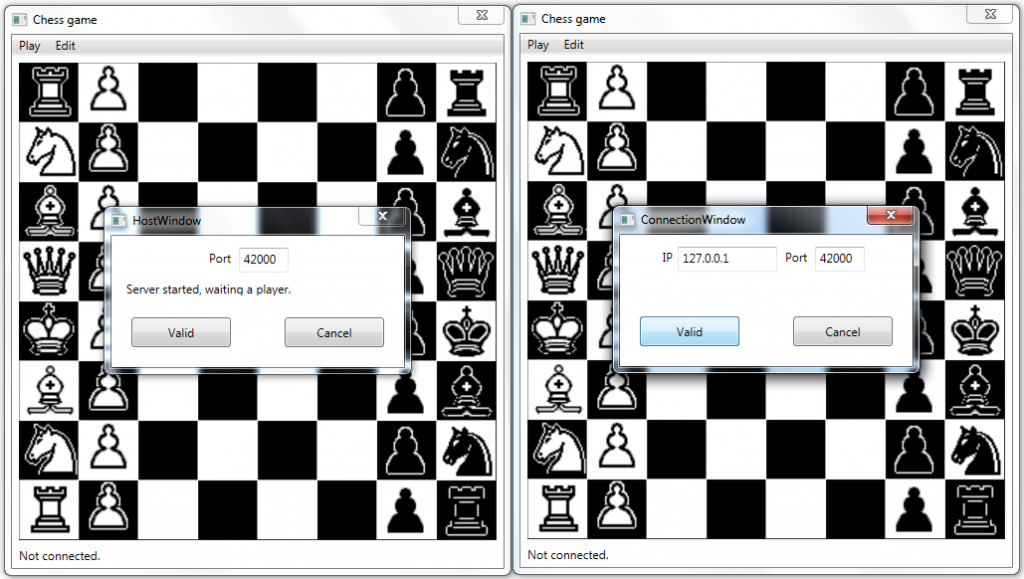
A small multiplayer chess game built in a day with WPF for a peer-to-peer networking project at Beijing Jiaotong University.
My second computer graphics project: a textured, lit Earth rendered with OpenGL's fixed pipeline, plus a fixed model importer and some blending tests.
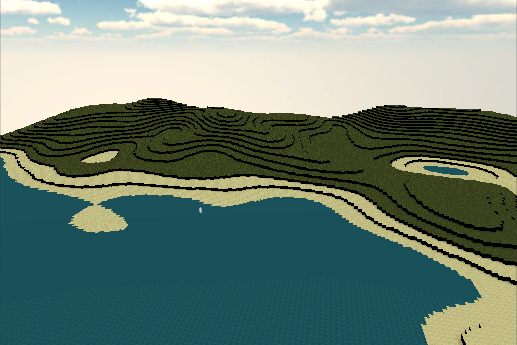
How each voxel fits in 4 bytes, how colored and sun light propagate through the terrain, and my first experiments with non-cubic block shapes.
My first computer graphics project of the year: a small solar system in C++ and OpenGL, with a custom .obj and .bmp importer, vertex arrays, lighting and textures.
Starting a school year at Beijing Jiaotong University, wrapping up the voxel engine, and an idea for evolving AI spaceships built from blocks.
A multithreaded chunk pipeline, the infinite-height lighting problem, transparent voxels, and a mesh collider that merges faces into large rectangles.
A Unity surface shader that dissolves objects outward from a projectile's impact point, with the shader and test script available.
The multiplayer-focused remake of my first Unity game: five weapons, an energy system and collision damage, and why I put development on hold.
Two hard-surface Blender models made after my dinosaur, and the lesson they taught me: plan the construction, and stop welding every detail into one mesh.
A simplex noise library for HLSL in 1D, 2D and 3D, with analytical derivatives and a seed instead of a lookup table, built for GPU terrain generation.
A GPU particle engine built in Unity with DirectX 11 compute shaders, after comparing CUDA, OpenCL and DirectCompute for my voxel terrain generator.
The first prototype of my infinite voxel terrain in Unity, three ways to extract its surface, and why Minecraft's cubes are a game design choice more than a technical one.
A primer on shaders: vertex and fragment programs, post-processing, Phong lighting, bloom and SSAO, and the input/output semantics most tutorials gloss over.
Why I chose collaborative diffusion over A* for the monsters of my end-of-year project: near-constant cost per crowd, emergent group tactics, and how to optimize it.
Escape, a Unity puzzle prototype made with e-artsup students for a game design module: guide a ball to the exit with objects whose behavior a trigger switches.
How tile engines draw 2D maps with layers, a tour of the modular map editor behind my end-of-year project, and the features I had to cut.
An Xbox game built in XNA over a whole school year: procedurally generated dungeons, a modular map editor, two classes and multiplayer.
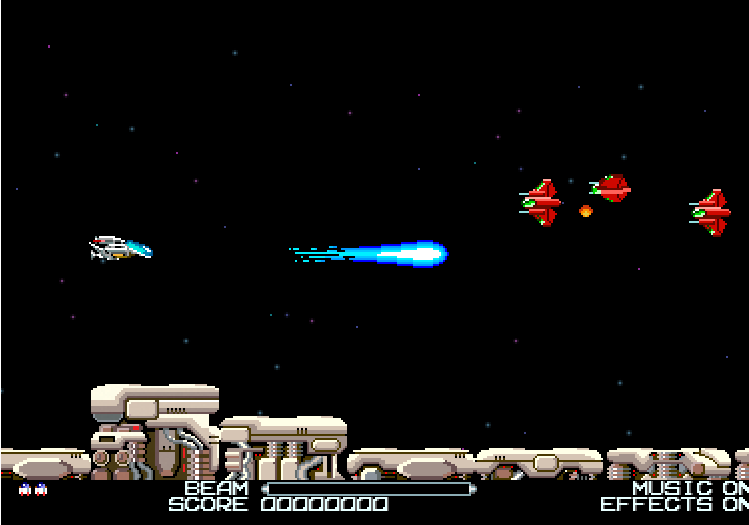
Our team's take on R-Type: a cross-platform C++ remake with a multi-game server and enemies loaded as plugins at runtime.
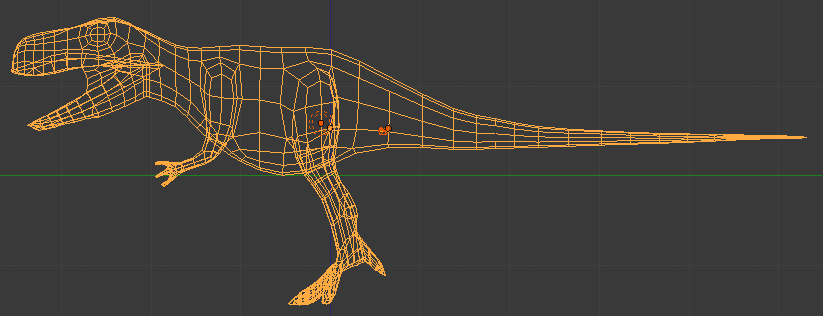
My first serious Blender model: a tyrannosaur with a rig and a walk cycle, exported to Unity, plus what learning 3D taught me about knowing the tools versus knowing how to build.
A 3D Bomberman in C++ and OpenGL from my second year at Epitech, and the mistakes I made with rendering, particles and AI.
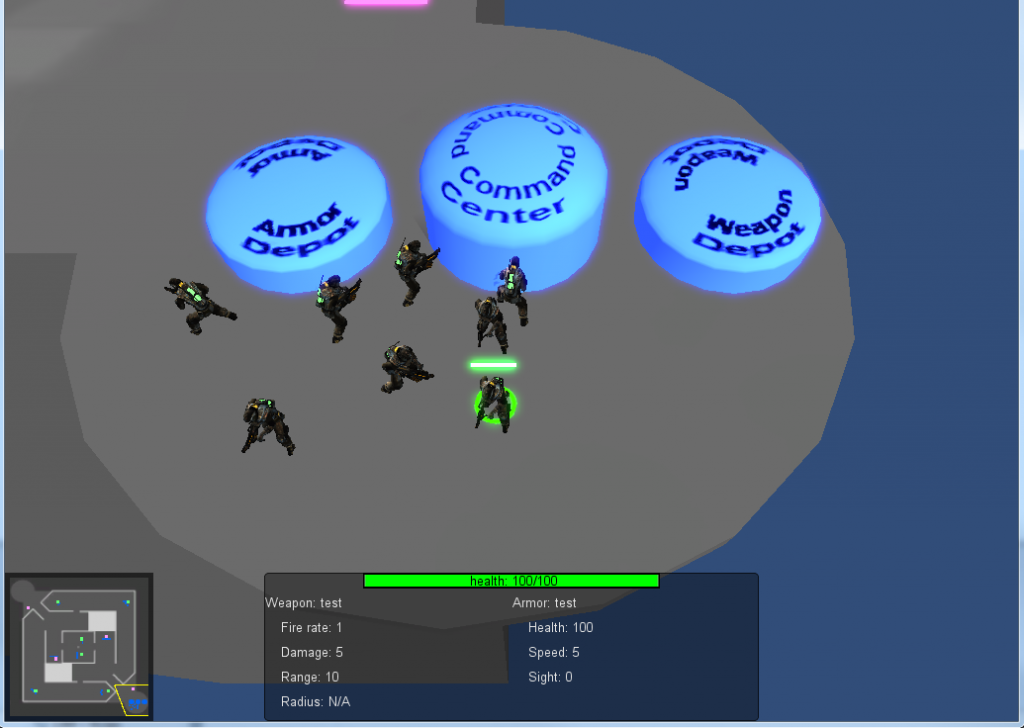
A Unity real-time strategy prototype built at the end of my second year: micromanagement, units equipped at depots, two resources and a weapon tech tree.
My first real game, built in Unity after my first year at Epitech: steer a rocket through three punishing levels, or fight a friend in two-player LAN mode.
My first major Epitech project: a raytracer in C with lighting, shadows, reflection and refraction, and a quick look at how ray-object intersection works.
No article matches these filters.